ANTONÍN GEHLERT
19 FEB 1876 · LADUNGThe main trace. Died in Gallipoli, Italy, on October 13, 1918.
 SPECIAL SCUBA DIVISION← PROJECTS
PROJECT IN MOTION · 01 DARDANELLES · GALLIPOLI
WHERE EMPIRES SANK
Two Gallipolis. One human story.

01 / THE SEARCH
WHERE EMPIRES SANK · ARCHIVES
A trace from the Dardanelles led us to the Ore Mountains, Italian captivity and a family still waiting for an answer years after the war.
We began with the wrecks. It soon became clear that ships were only the visible end of a much wider story. Behind their names stand military units, hospitals, prisoner-of-war camps, burial grounds — and above all, people.
The search led us through military archives, old newspapers, official gazettes and death registers. The more answers we find, the more questions appear. One name took us all the way to the Ore Mountains.
01 / A NAME ON A LIST
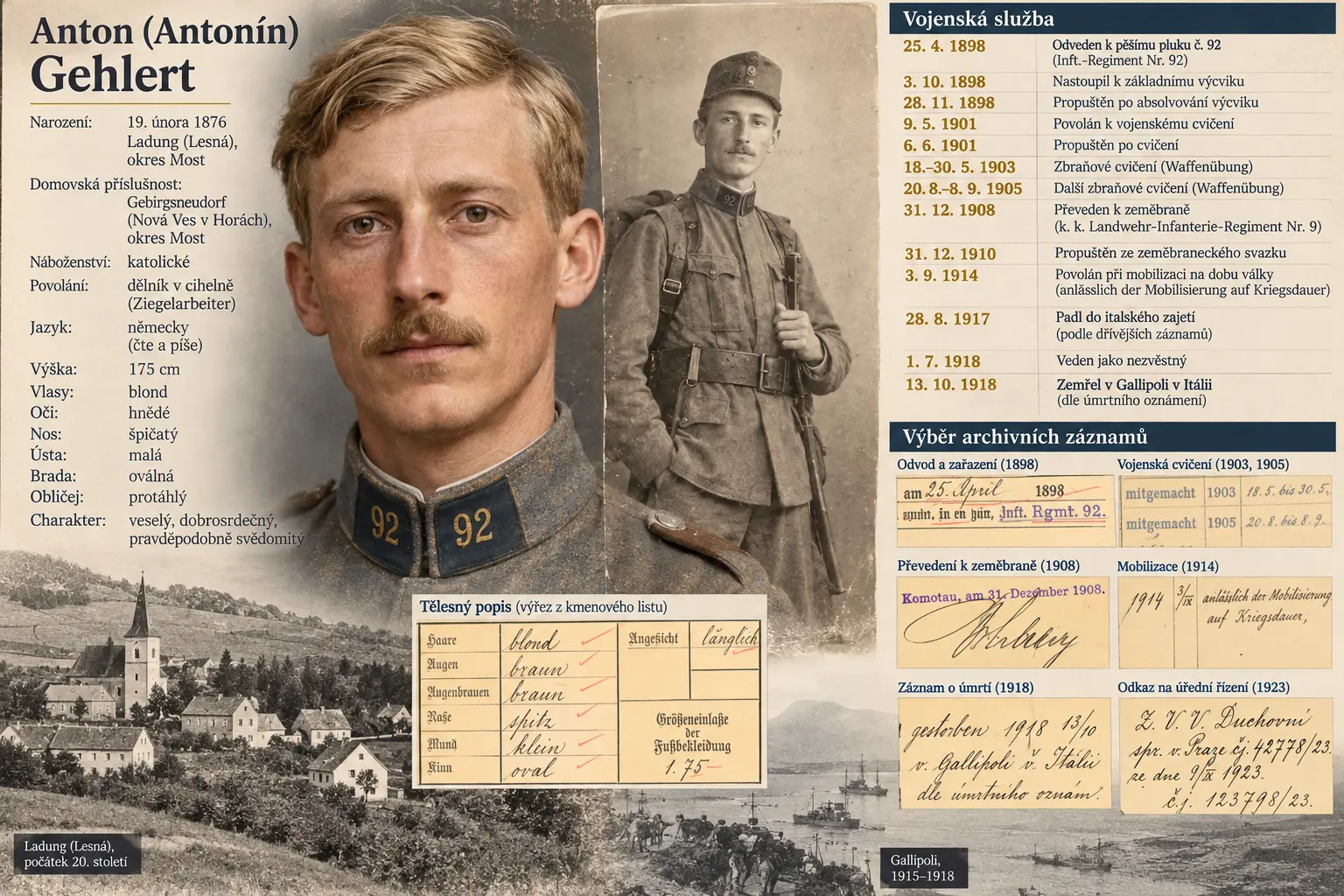
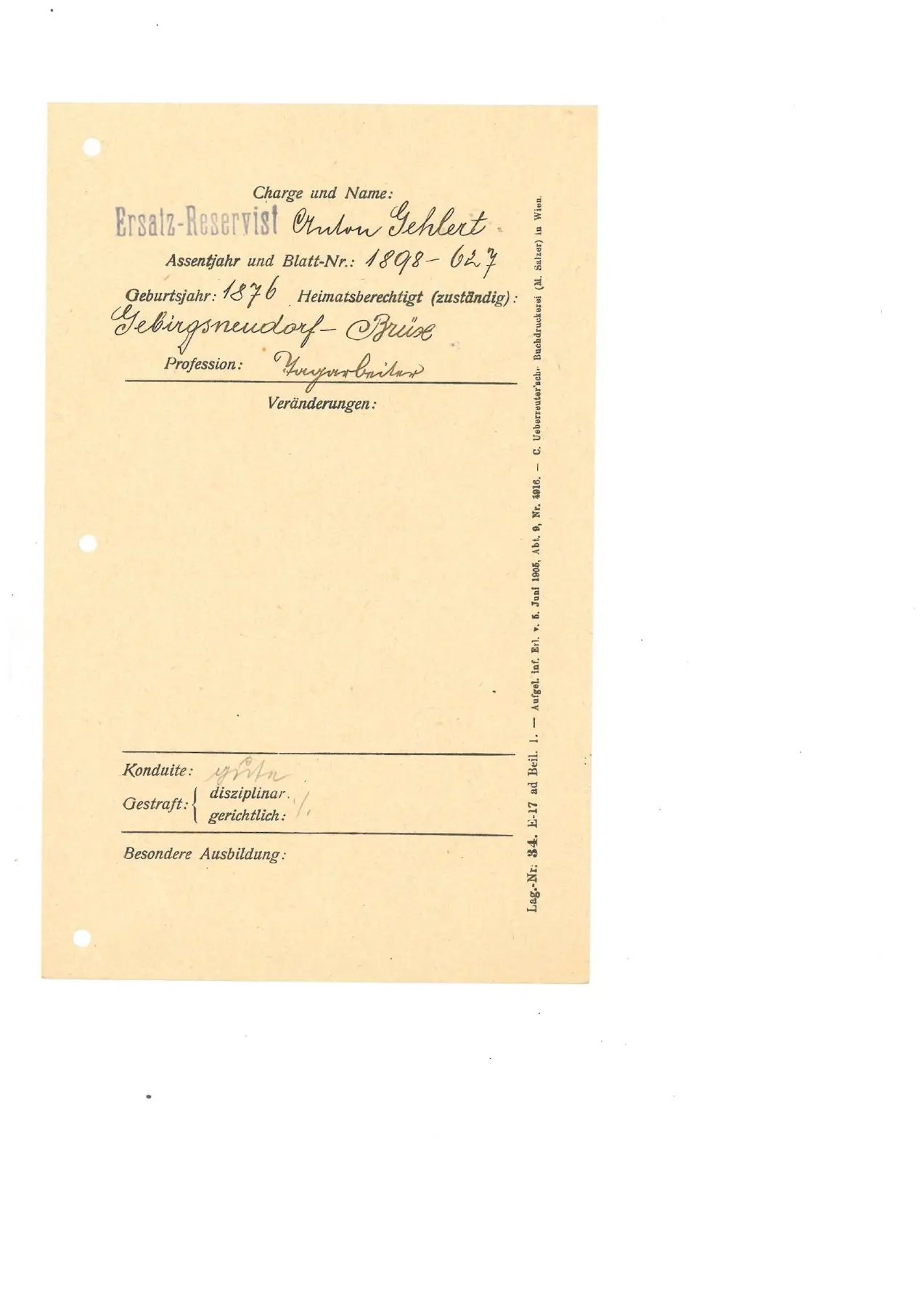
Antonín Gehlert was born on February 19, 1876, in Ladung, now Lesná in the Ore Mountains. His legal home was Gebirgsneudorf, today Nová Ves v Horách.
A working list of men associated with Gallipoli gave his place of death and burial simply as Gallipoli. Because we were tracing Austro-Hungarian soldiers linked to the Dardanelles, it seemed that another story led directly to Turkey.
The name, birth date and military unit looked convincing. But research cannot stop at what appears plausible. Every detail must be tested against other sources. A seemingly simple trace began to change direction.
02 / A MAN FROM THE ORE MOUNTAINS
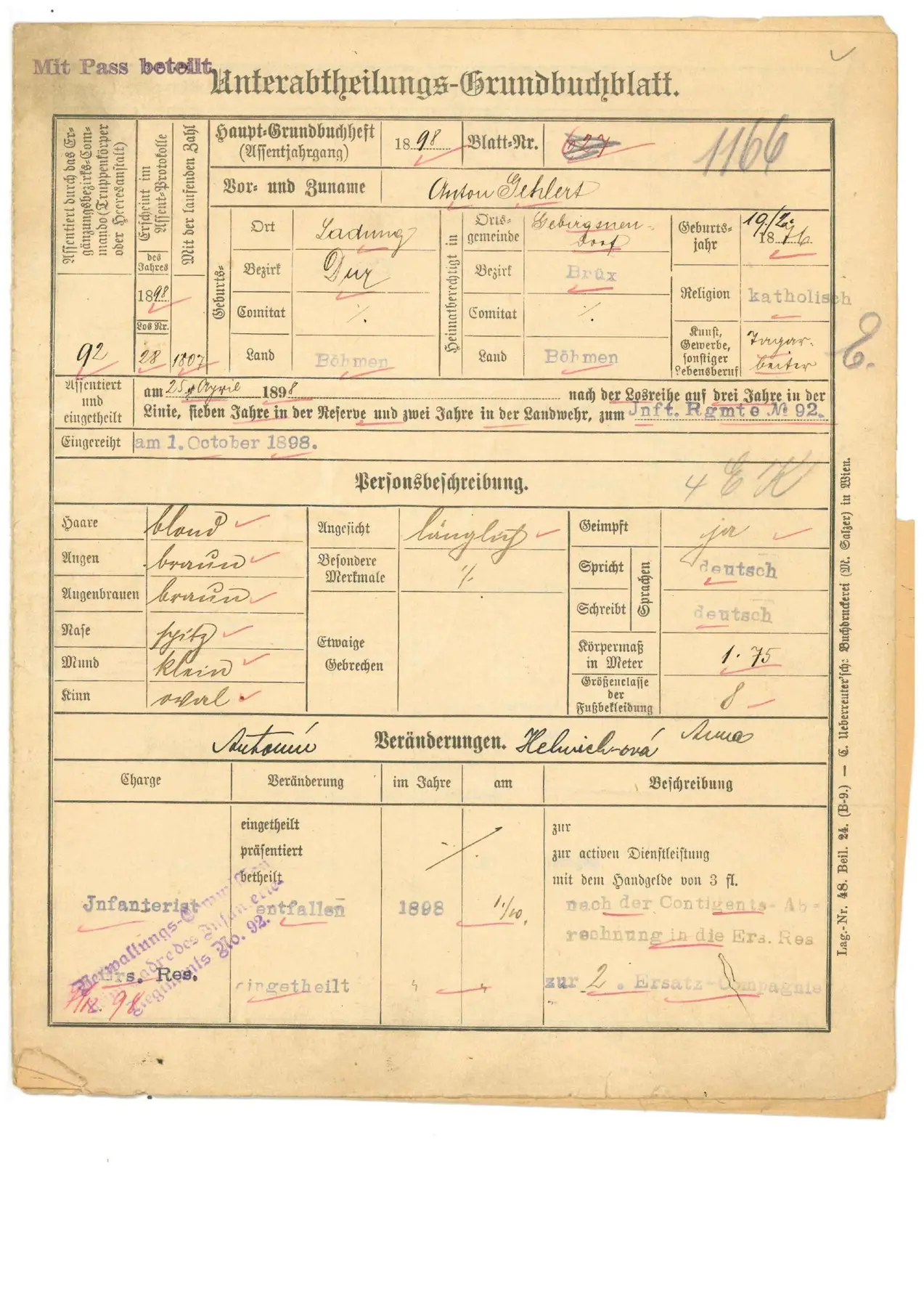
German-language military papers name him Anton Gehlert. He was a Roman Catholic, read and wrote German and stood about 175 centimetres tall. He had fair hair, brown eyes, a pointed nose, a small mouth, an oval chin and a long face.
One record calls him a ‘Ziegelarbeiter’ — a brickworks labourer. A later Czechoslovak notice calls him a forestry worker in Ladung. Perhaps he changed jobs; perhaps an official recorded it incorrectly. We leave the contradiction visible.
Antonín was married. His wife Marie lived at house number 16 in Ladung. The documents preserve a handful of facts, but a great silence remains between the lines.
03 / MILITARY LIFE
Antonín was drafted into Infantry Regiment No. 92 on April 25, 1898, and completed his first training that autumn.
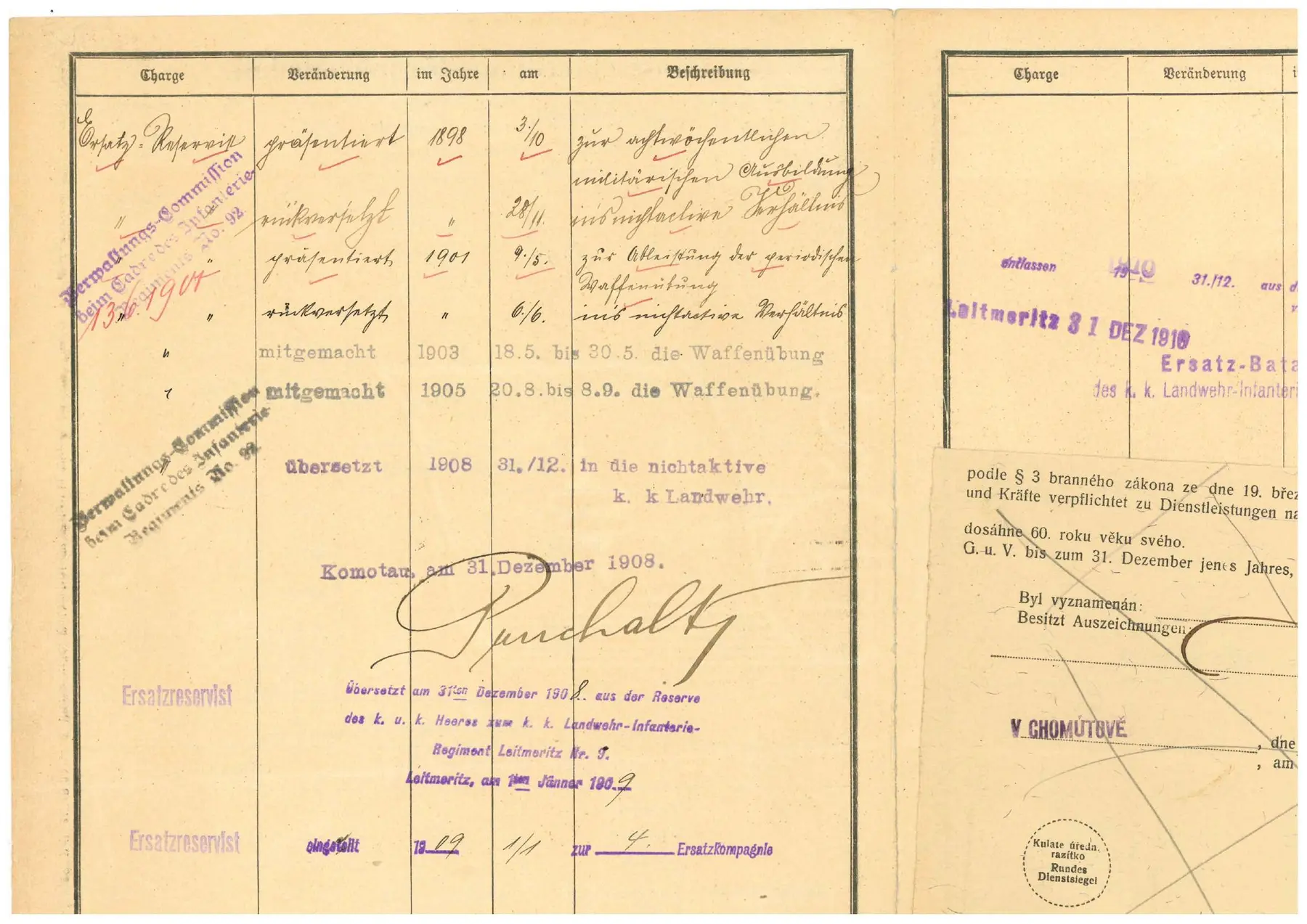
He returned for exercises in 1901, 1903 and 1905. In 1908 he transferred to Landwehr Infantry Regiment No. 9. His obligation at that time ended on December 31, 1910.
On September 3, 1914, he was called back for the duration of the war. He was thirty-eight, a married working man leaving Ladung while Marie remained at home. His exact route across the battlefields is still unknown.
04 / THE TRACE BRANCHES
The search led us to other men with the same surname, all from a small area of the Ore Mountains.
Another Antonín Gehlert was born in Rudolice in 1890. Ferdinand Gehlert, born there in 1873, died of pneumonia in a field hospital near Ferizovič in 1918. A death-register index produced yet another Antonín, but the referenced entry could not be found.
Were they related, or was this simply a recurring surname? We do not yet know. Records must never be merged by name alone. Birth date, birthplace, legal home, unit and service chronology all have to agree.
The main trace. Died in Gallipoli, Italy, on October 13, 1918.
A namesake from the same region. A separate life.
Died in a military hospital near Ferizovič in 1918.
05 / OFFICIAL GAZETTE · 1923
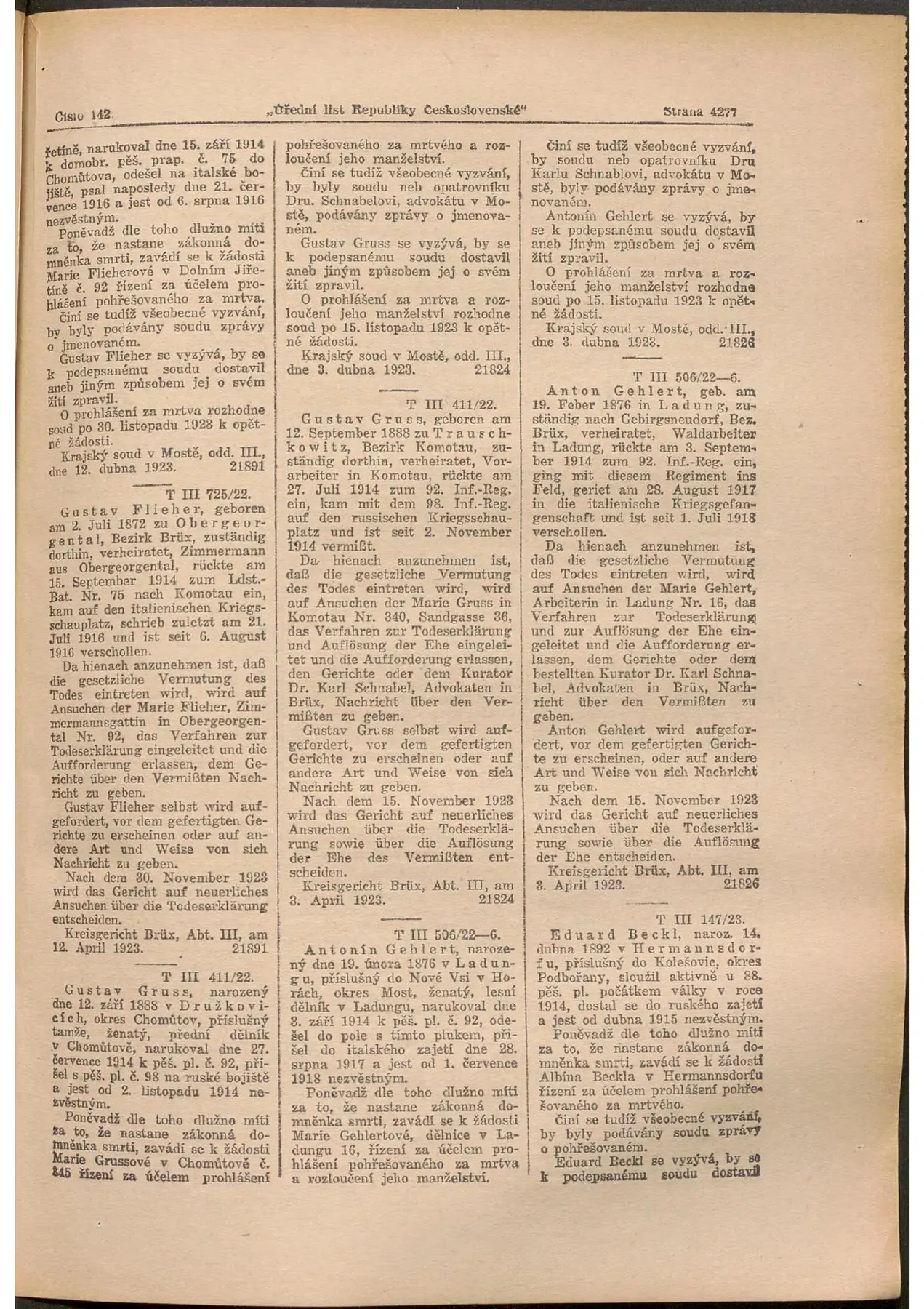
Five years after the war, Antonín’s story reappeared in the Official Gazette of the Czechoslovak Republic. The notice of June 26, 1923, concerned proceedings begun by his wife, Marie Gehlertová.
Antonín had been listed as missing since July 1, 1918. He did not return, and the family had no official confirmation of whether he lived or died. Marie asked the court to declare him dead and dissolve the marriage.
The notice called upon Antonín to report if he was alive and asked anyone who knew his fate to contact the court. Behind the dry legal language stands a woman still waiting for an answer years after the war.
06 / THE LAST KNOWN JOURNEY
Antonín entered Italian captivity on August 28, 1917. We still do not know where or under what circumstances. From July 1, 1918, he was listed as missing.
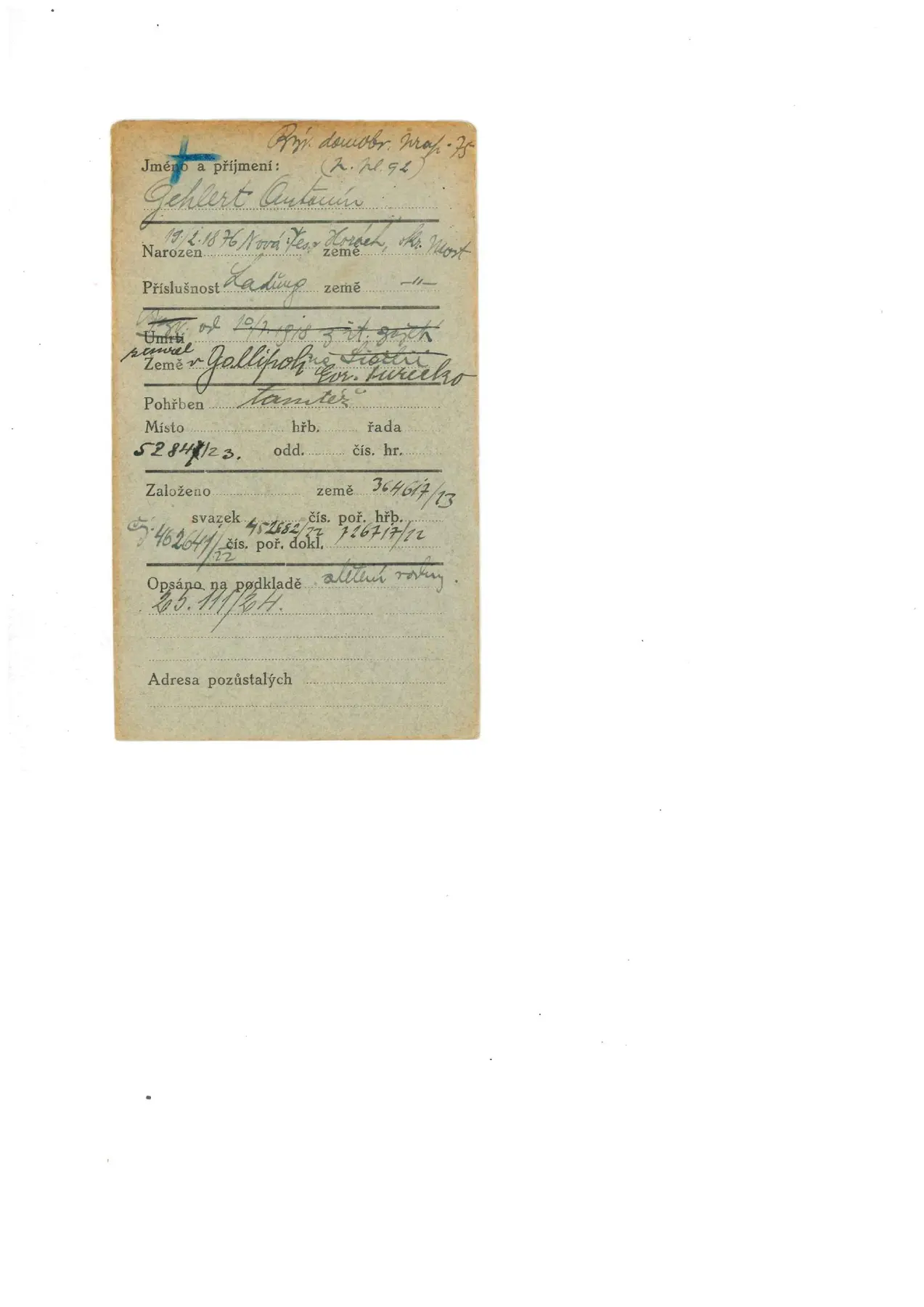
A military record says that he died on October 13, 1918, in Gallipoli. Not Gallipoli on the Turkish peninsula by the Dardanelles, but Gallipoli in southern Italy. A single geographical note changed the entire story.
The original connection to the Turkish Dardanelles was wrong. Correcting such errors is one of the reasons we search.
07 / GALLIPOLI, ITALY · 1921
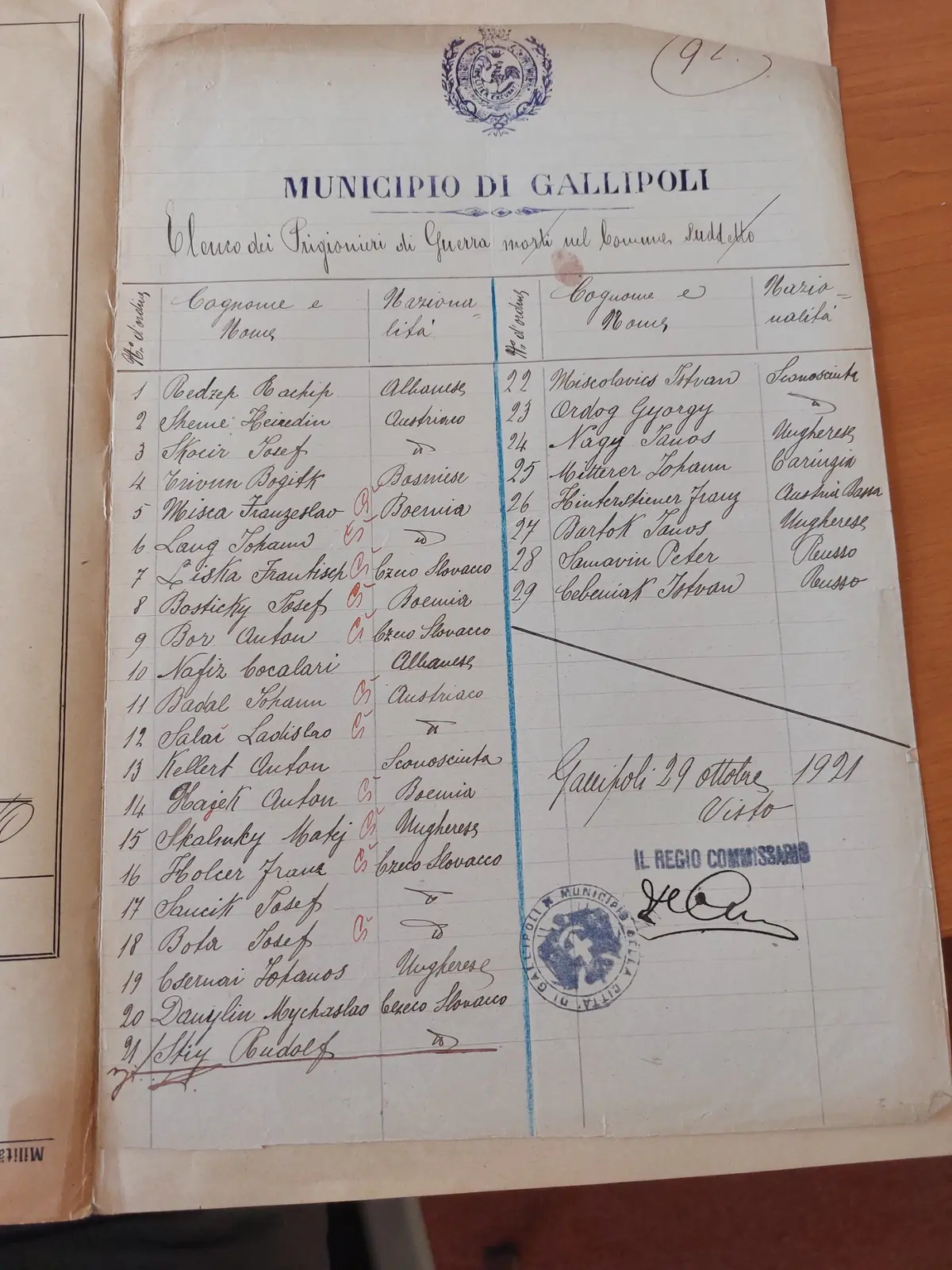
An Italian municipal register of prisoners of war who died in Gallipoli names a man on line thirteen as ‘Kellert Anton’. His origin is marked ‘Sconosciuta’ — unknown.
It may be a corrupted rendering of Gehlert. Yet the line alone proves no identity. We consider the connection probable, not final. The decisive source is a separate military record naming the same date of death and Gallipoli in Italy.
We do not hide the uncertainty. It remains part of the story.
08 / OPEN QUESTIONS
A burial card says Antonín was buried ‘there’ — in Gallipoli, Italy. We do not know the exact grave, whether his remains were later moved, or what caused his death.
Antonín died less than a month before the war ended. None of the documents found so far tells us whether he died from illness, wounds or the effects of captivity.
09 / BACK TO THE PRESENT
Antonín proved to be a false lead to the Turkish Dardanelles. His story, however, was not a dead end.
It began with one line on a list. We now know his birthplace, home, military service, his wife’s name and the place and date of his death — and how many questions remain.
History rarely assembles itself in a straight line. A convincing fact proves wrong. A document found a century later moves an entire story to another country. That is why we compare sources and preserve contradictions.
Where Empires Sank is not only the story of ships left beneath the surface. It is also the story of men whose names remained between the pages of archives — and of families who sometimes never received an answer.
The search continues.
We use Cloudflare Web Analytics to measure traffic and technical performance. According to Cloudflare, this tool does not store cookies or track individual visitors across websites. It provides only aggregated statistics about traffic, devices and website performance.
Pro měření návštěvnosti a technického výkonu používáme Cloudflare Web Analytics. Podle společnosti Cloudflare tento nástroj neukládá cookies, nesleduje jednotlivé návštěvníky napříč weby a poskytuje nám pouze souhrnné statistiky o návštěvnosti, používaném zařízení a výkonu webu.