Places once shaped by people are slowly returning to nature.
Echoes of the Underground is our project about places where more than empty tunnels remain below the surface. We follow the guideline, but we also look for traces of the past and stories of the people who once worked here.
We came to Felicitas as a team of two — me and my buddy Petr. At the end of August 2026, we made two dives into a world of slate, old rails and mining machines left underground after the mine closed.
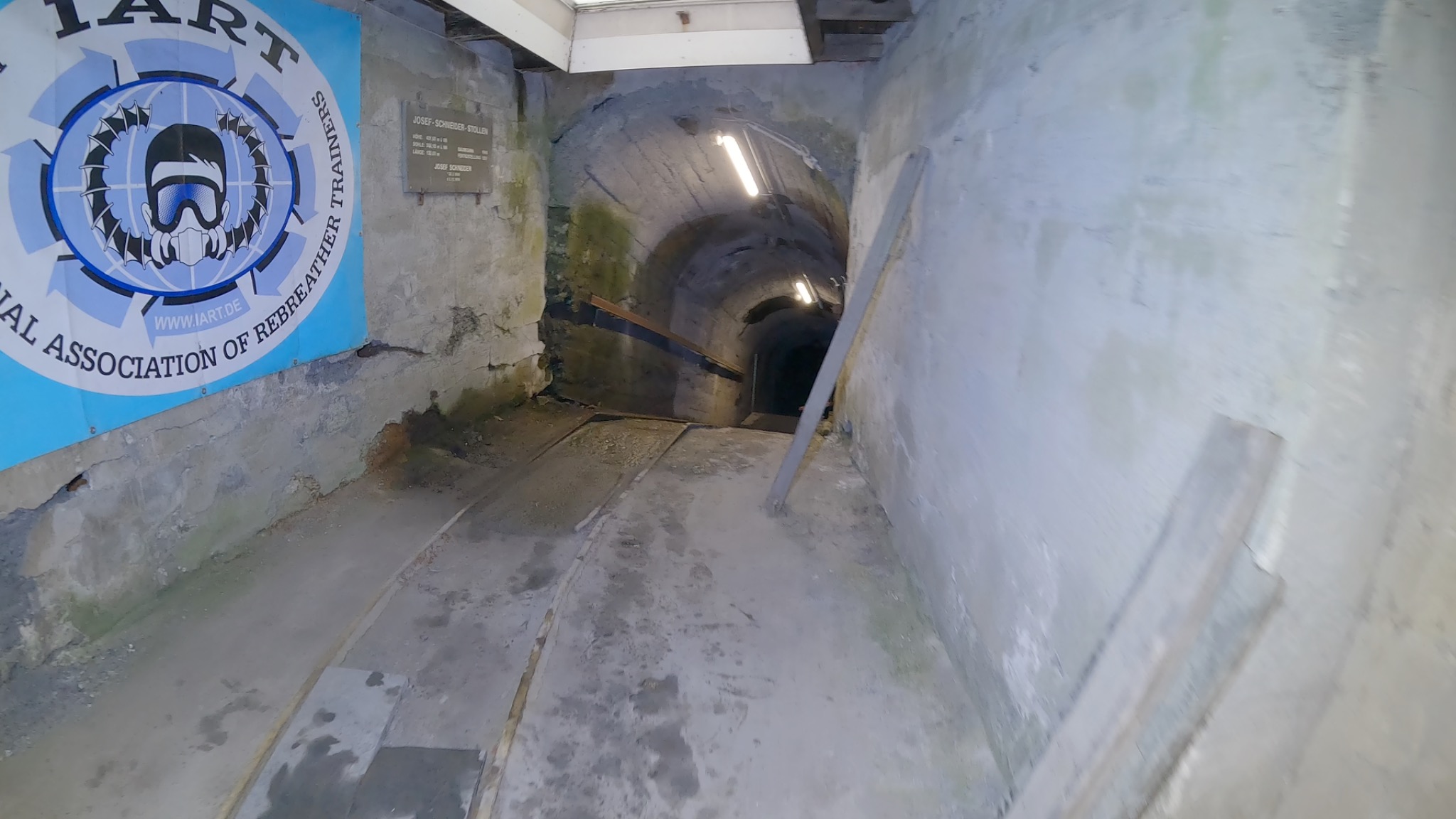
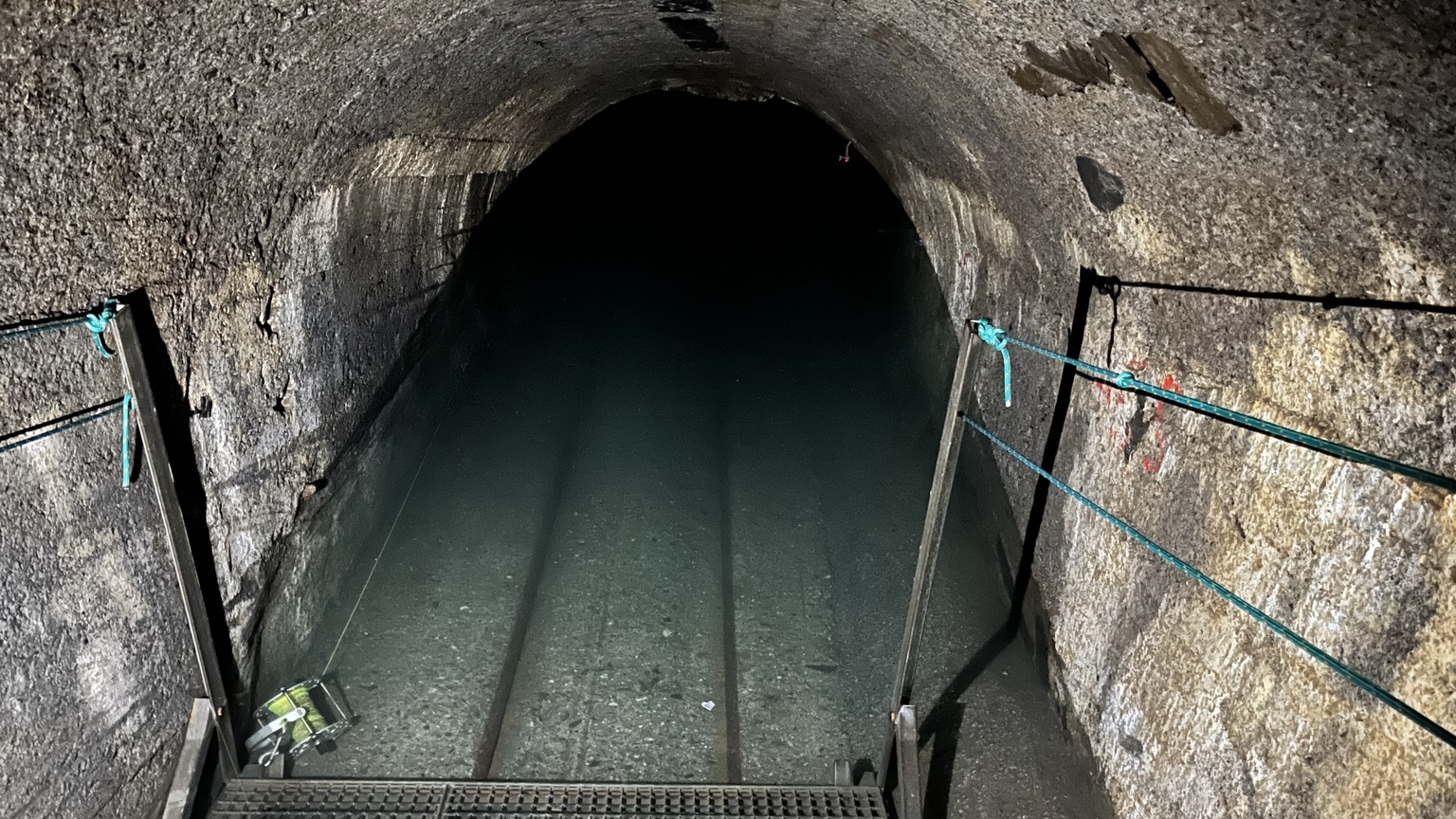
JOSEF-SCHNEIDER-STOLLEN · THE RAILS DISAPPEAR INTO THE WATER
02 / SAUERLAND
A landscape shaped by slate.
Sauerland is a region of forests, hills and small towns. But for generations, mining was also an important part of life here.
Slate provided work for local miners, transport workers and craftsmen. The stone was used for roofs and walls, and Felicitas was also known for producing traditional school writing slates.
Behind the small entrance to the mine is much more than a dive site. It is a place connected with more than a century of hard work underground.
03 / FELICITAS MINE
FROM HAND WORK TO MACHINES
More than a century underground.
Slate mining at Felicitas started in 1863.
An important change came in 1947 and 1948, when miners built the Josef-Schneider-Stollen, a 120-meter inclined tunnel leading into the mine.
During the 1950s and 1960s, almost 80 people worked here. Slate from Felicitas was used far beyond the local area.
Mining also became more modern. In 1972, a mobile slate saw was introduced underground. It allowed miners to cut large blocks of slate directly inside the mine.
In 1980, another machine was added. It was used to loosen, load and transport heavy pieces of stone without using rails.
1863
Slate mining begins at Felicitas.
1947–1948
The 120-meter Josef-Schneider-Stollen is built.
1950s–1960s
Almost 80 people work in the mine.
1972
A mobile slate saw is introduced underground.
2000
Underground mining ends.
2011
The pumps are switched off and groundwater starts to flood the mine.
04 / THE LAST SHIFT
WHEN THE PUMPS STOPPED
Mining ended. The water returned.
Underground mining ended in 2000. A few people continued to work with imported slate in the workshops on the surface.
The final change came on June 1, 2011. The last miner retired and the pumps were switched off.
Groundwater slowly returned to the mine.
For many years, the pumps had kept the mine dry. When they stopped, the old workplace slowly disappeared under water.
Today, the rails continue below the surface and many of the machines are still where the miners left them.
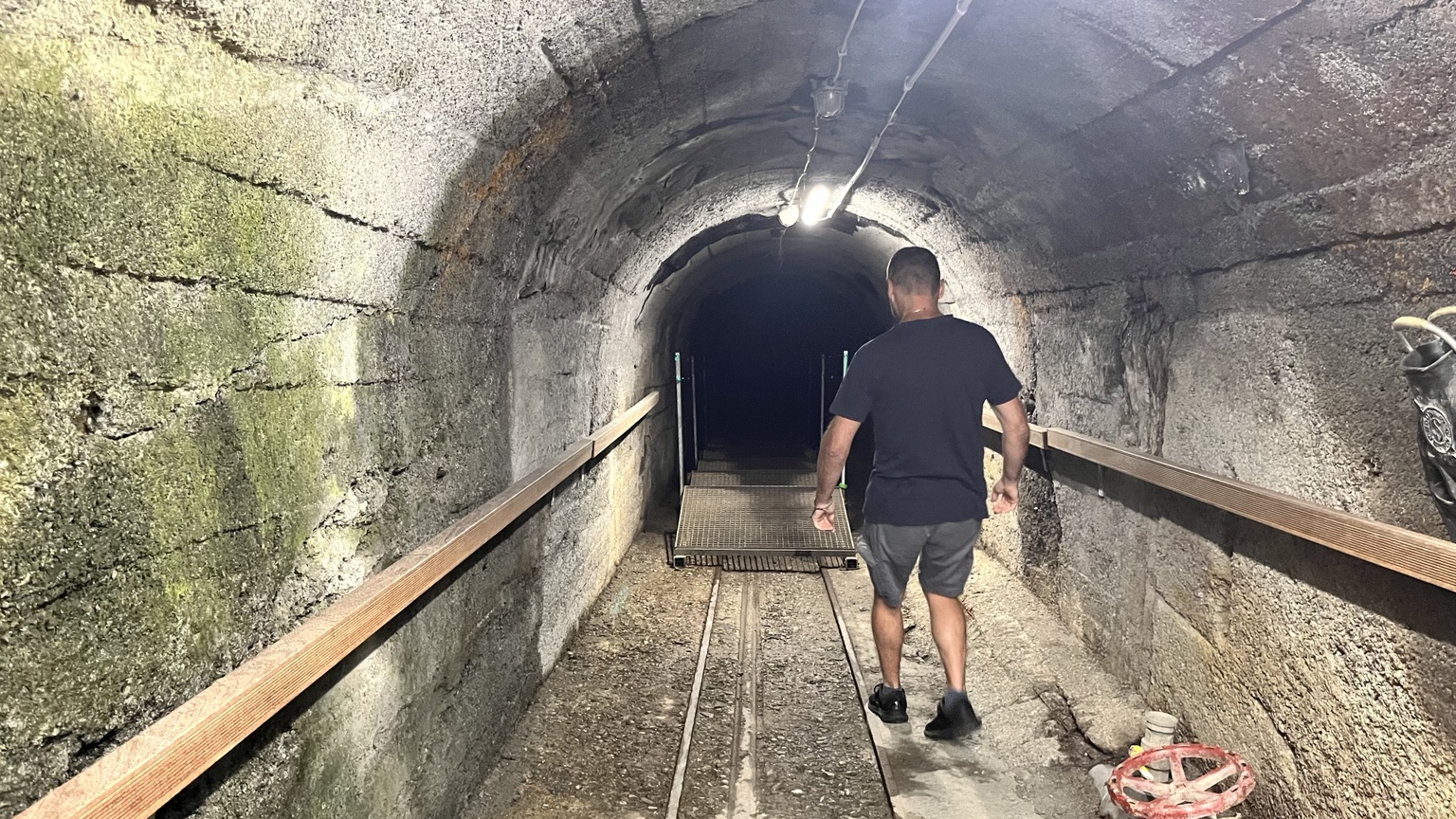
THE WAY UNDERGROUNDWHERE THE TUNNEL CONTINUES BELOW THE WATER
05 / TWO DIVES
AUGUST 29, 2026
First to the right. Then to the left.
Both dives lasted about 65 minutes. Most of the time we were at a depth of around 27 meters.
During the first dive, we followed the right side of the mine. In the light of our lamps, an electric motor, lifting equipment and other old mining machines slowly appeared from the darkness.
For the second dive, we went to the left side.
Visibility was worse than during the first dive, but we could still follow the tunnel and see the machines around us.
This was the moment when Felicitas really became an industrial museum under water for us.
There are no glass cases. No information boards.
The history is still exactly where the miners left it.
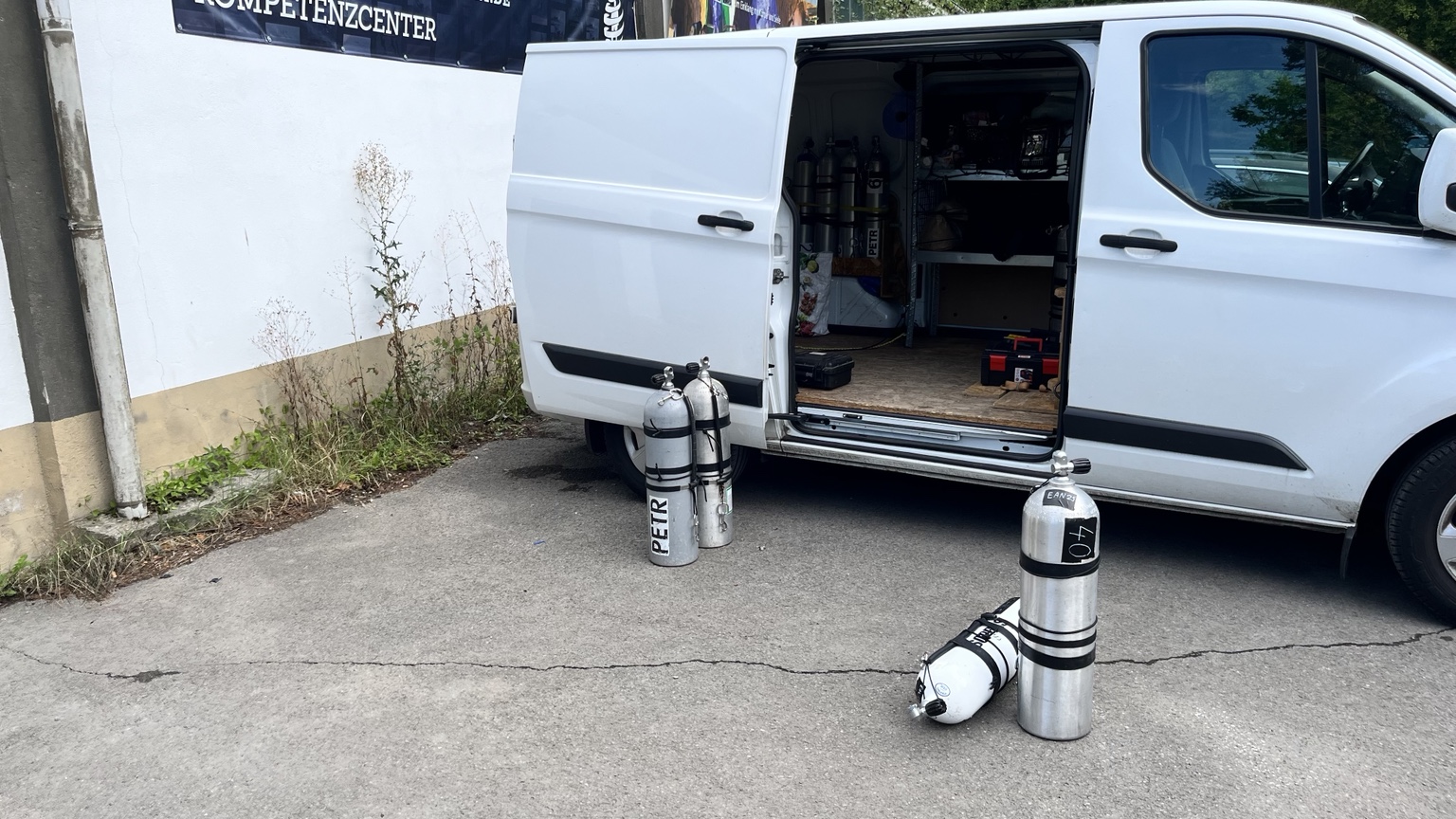
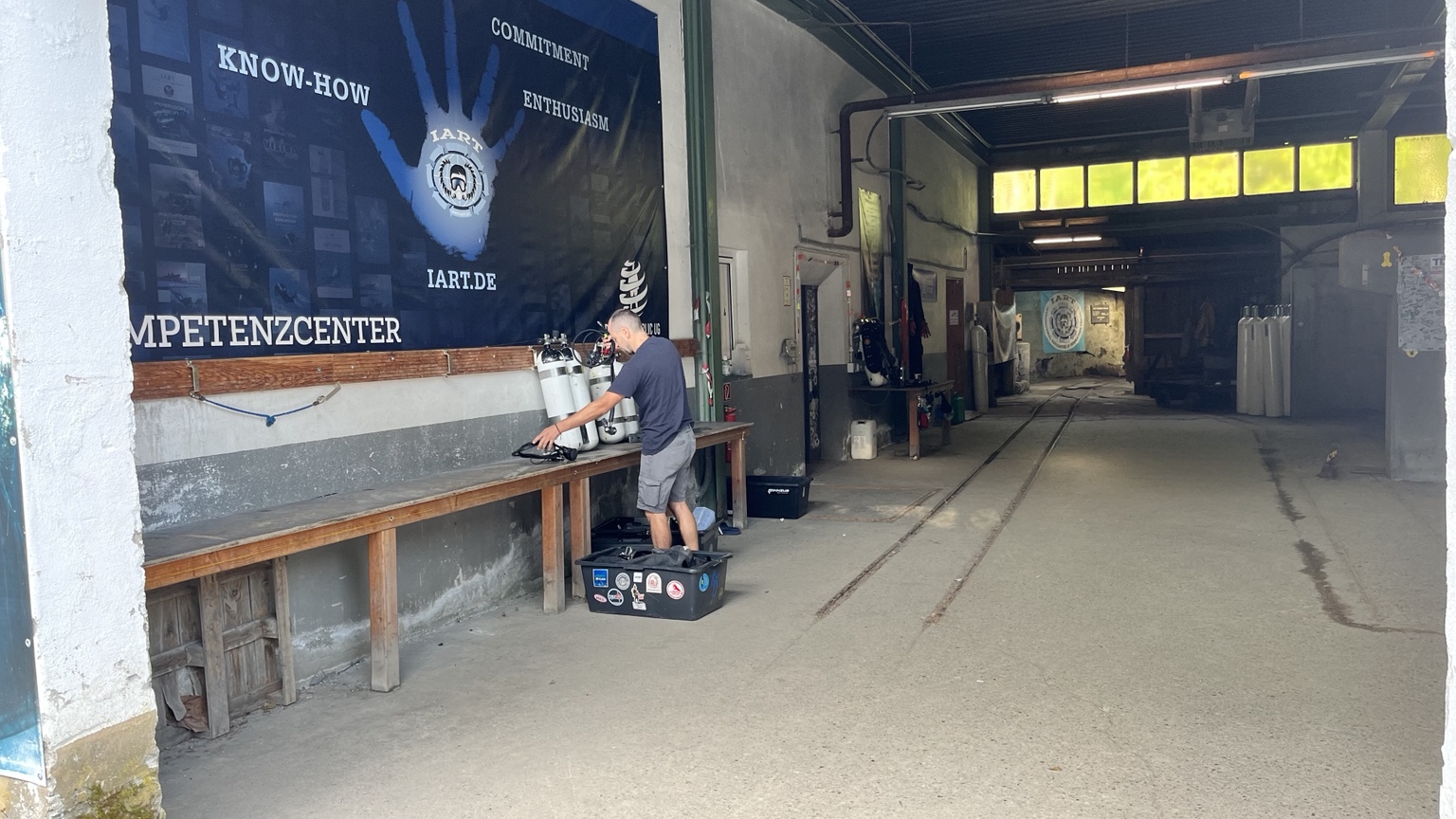
ARRIVAL · FELICITASPREPARING FOR THE DIVE
06 / MACHINES
TRACES OF THE OLD MINE
The machines are still there.
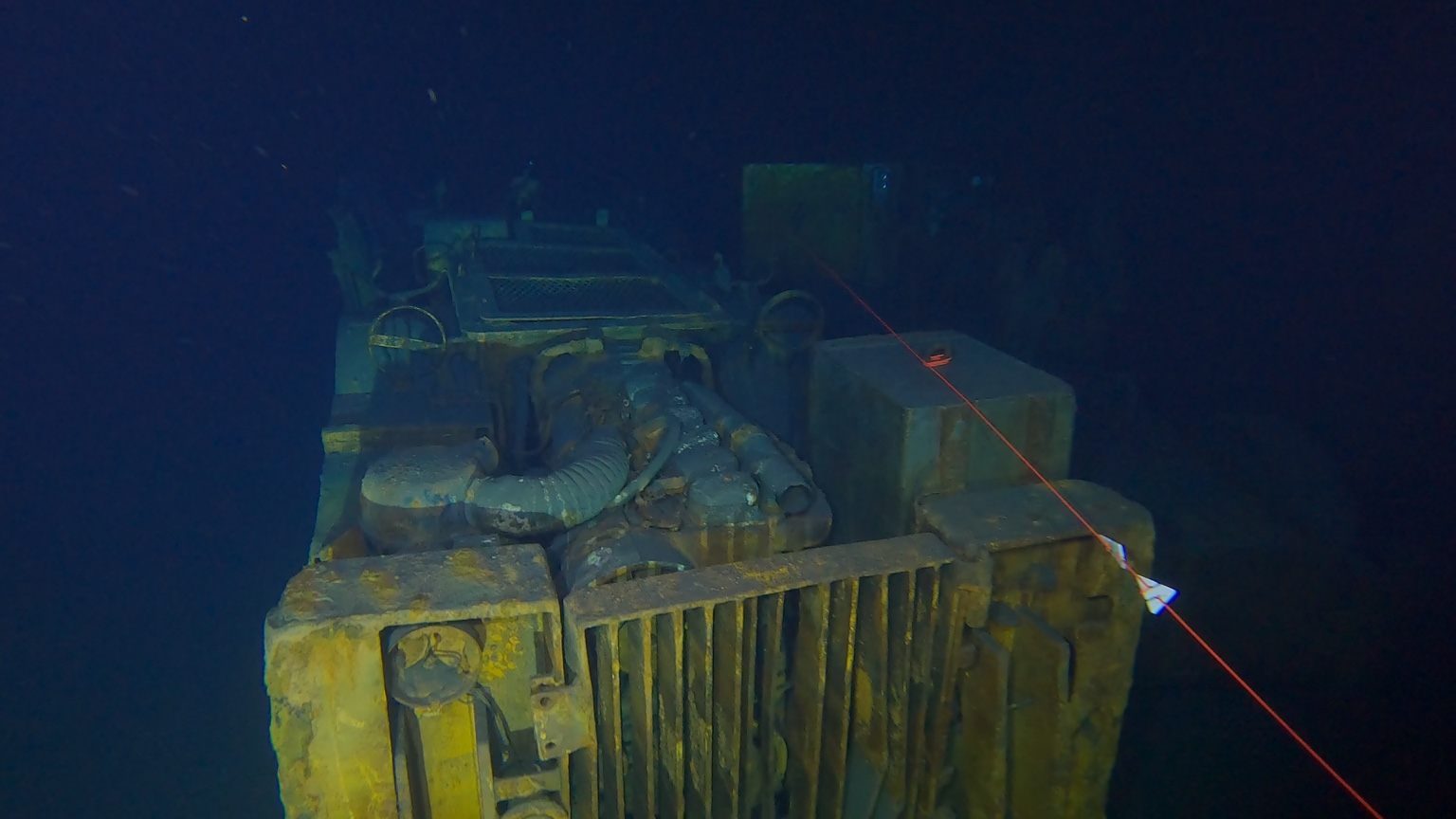
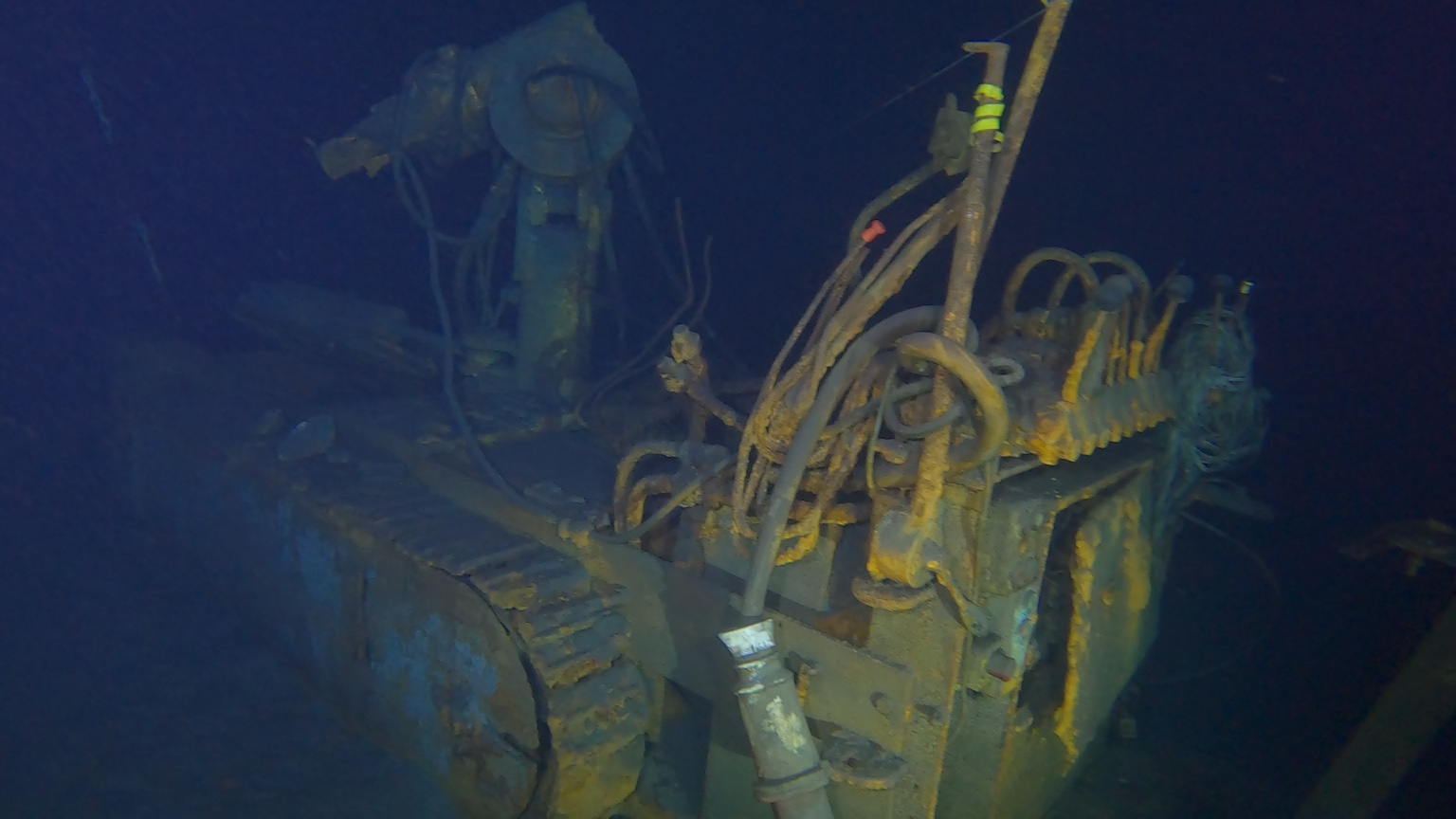
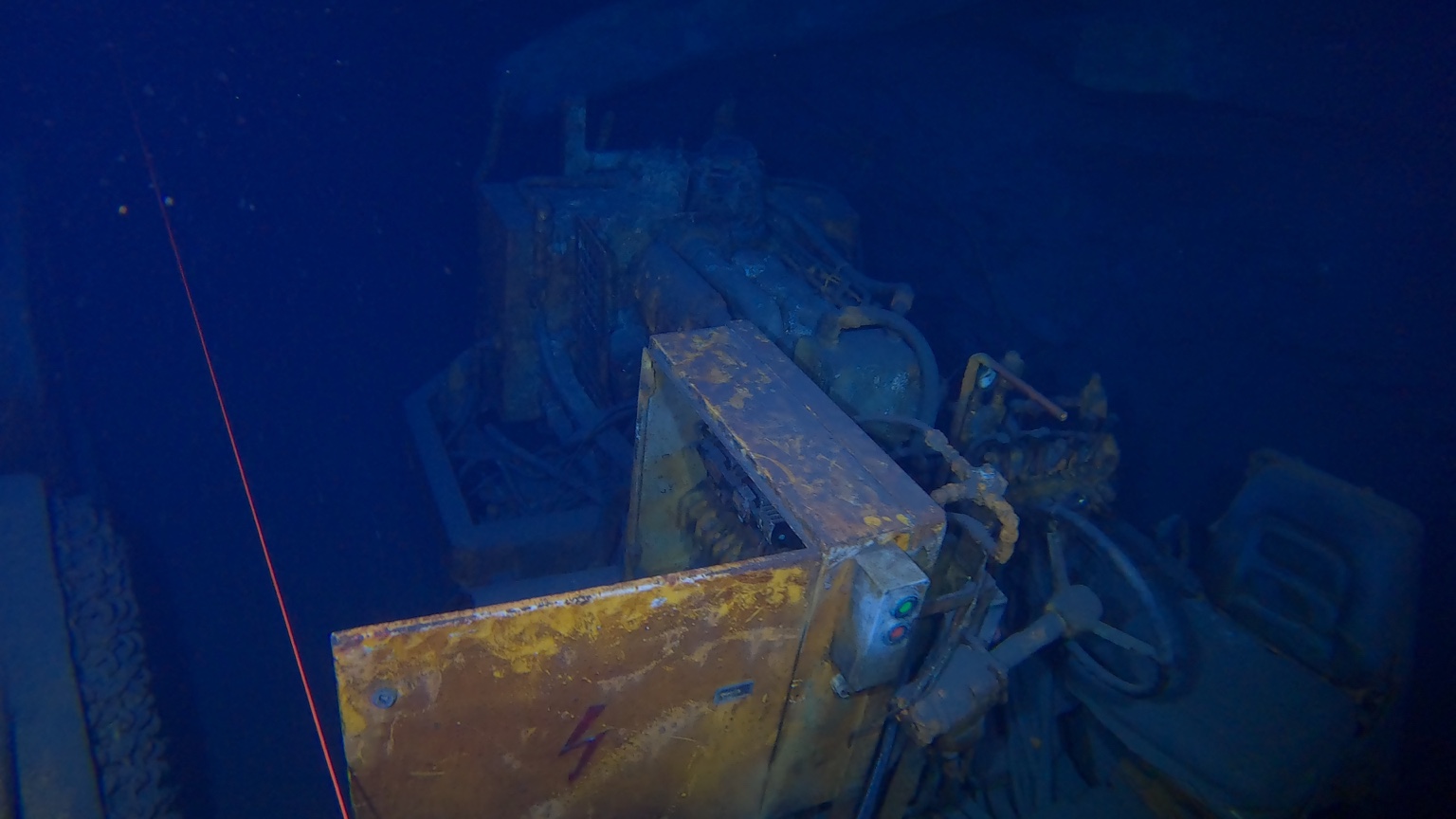
Inside one of the flooded parts of the mine, we found a large mining machine.
Its design looks very similar to the mobile slate saw described in historical information about Felicitas.
We cannot say for sure what exact type of machine it is. We also cannot confirm that it is the same machine shown in old photographs.
But the similarities are very interesting.
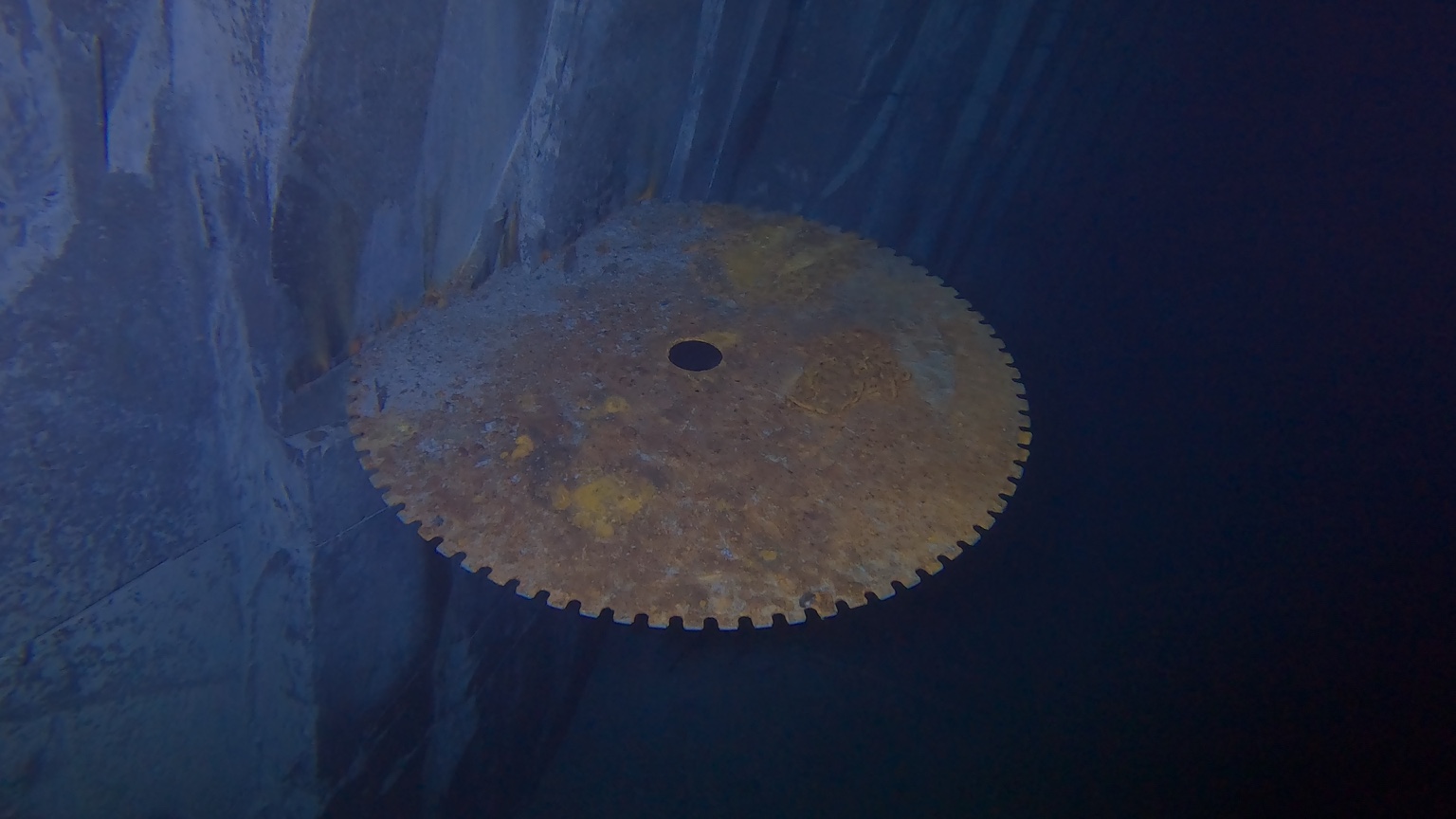
Only a short distance away, a large circular saw blade is still visible in the rock wall.
We cannot prove that the saw blade belonged to this particular machine.
But together, the machine and the blade give us an idea of how miners once cut large blocks of slate directly from the rock.
MINING MACHINE · PART OF THE OLD MINE EQUIPMENTTHE LARGE SAW BLADE STILL IN THE ROCK
07 / ANOTHER MACHINE
Built for hard work underground.
During the second dive, in the left part of the mine, we found another large machine.
Its heavy construction looks similar to the type of machine introduced at Felicitas around 1980. These machines were used to loosen, load and transport large blocks of slate.
Again, we do not want to say that we know the exact model.
We can only compare what we saw under water with the historical information available about the mine.
For us, this is also part of exploration.
We see something under water, document it, and later try to understand what it was and how people used it.
SECOND MACHINE · LEFT SIDE OF THE MINE
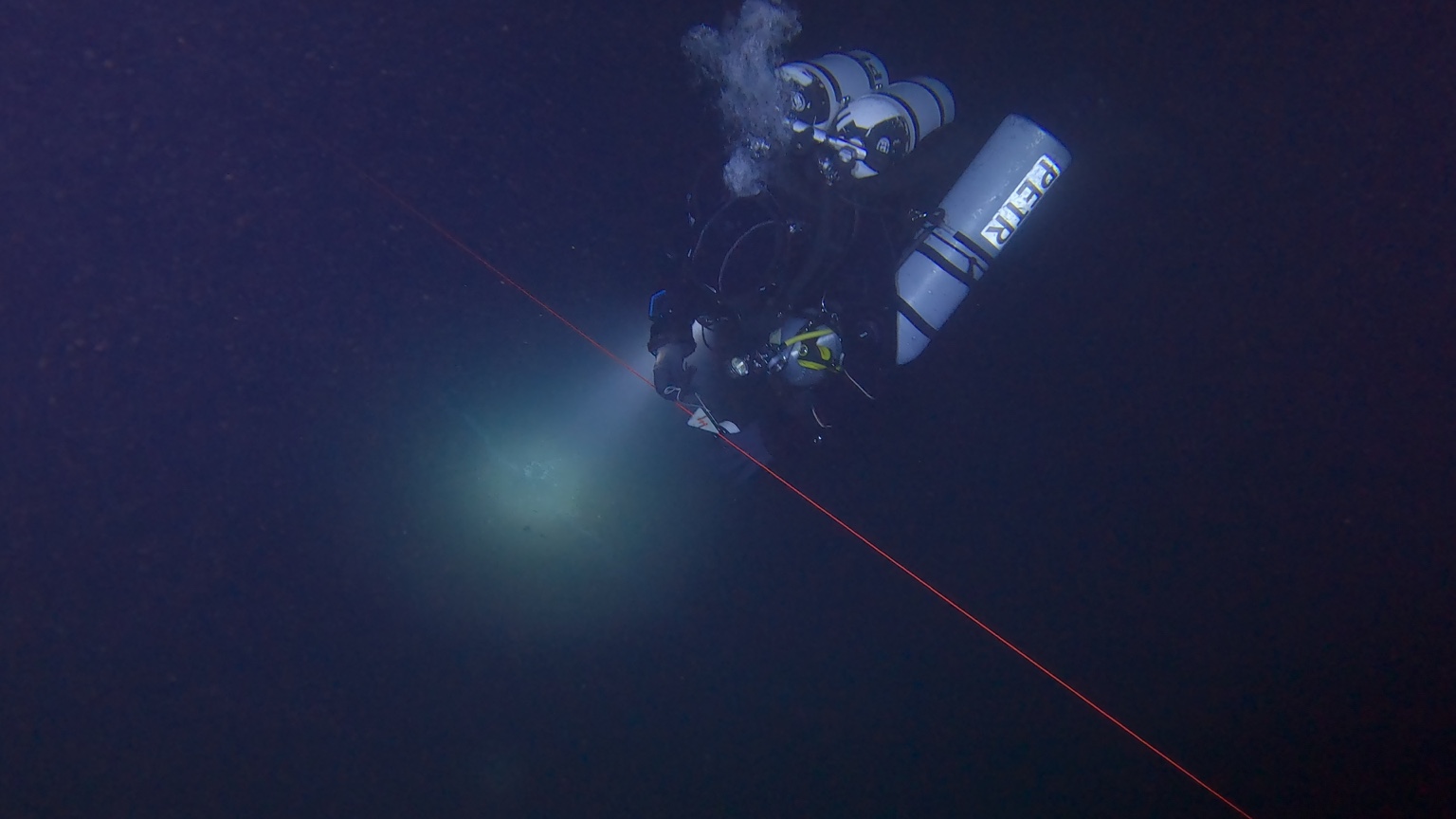
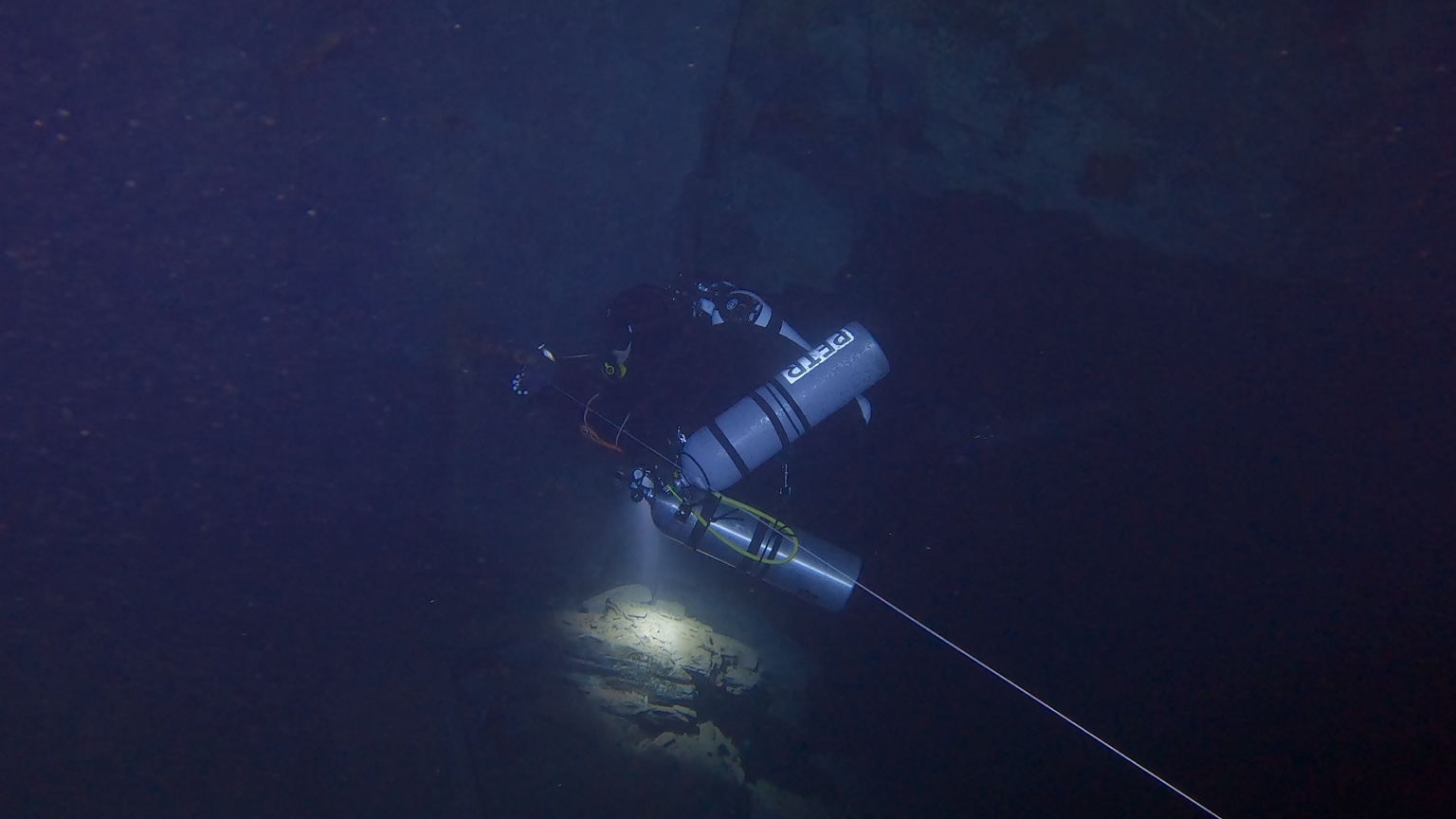
PETR · FOLLOWING THE GUIDELINELIGHT IN A PLACE WHERE YOU CANNOT SEE EVERYTHING AT ONCEFOLLOWING THE SAME WAY BACK
08 / UNDER WATER
We are not diving through an empty mine. We are moving through a place where people worked only a few decades ago. Their story is still here.
This is what makes mine diving special for us.
The guideline shows us the way.
But the things around it tell the story.
09 / VIDEO FROM THE EXPEDITION
Felicitas in motion.
2026 · CAVE DIVING ADVENTURE TRUST THE LINE · FELICITAS
10 / WHAT REMAINS
Nature is coming back. The story remains.
Water is slowly changing the mine.
Metal is covered by sediment. The noise of machines and people has been replaced by silence.
But the human traces inside Felicitas are still easy to see.
The machines, the large saw blade, the rails and the old working areas were not placed here for divers.
They are original parts of this mine.
That is why Felicitas was much more than another dive in a flooded mine for us.
We came here because we wanted to see the old mining machines.
But in the end, we found much more.
We found a place where diving, industrial history and human stories meet under water.
The mine did not disappear. It simply changed.
DID YOU ENJOY THIS STORY?
With one click, you can support more stories from our expeditions.
SOURCES
Historical information is based on public information from the municipality of Sellinghausen and the operator of the Felicitas diving site.
The descriptions of our dives and our interpretation of the machines are based on what we saw and documented under water. Where we cannot identify a machine with certainty, we clearly describe it only as a possible identification.
Pro měření návštěvnosti a technického výkonu používáme Cloudflare Web Analytics. Podle společnosti Cloudflare tento nástroj neukládá cookies, nesleduje jednotlivé návštěvníky napříč weby a poskytuje nám pouze souhrnné statistiky o návštěvnosti, používaném zařízení a výkonu webu.